
4 min read
A Native American pattern motif is a repeated geometric unit—diamond, step, whirling log, or cross—drawn from the textiles, beadwork, or pottery of specific Indigenous nations. Each motif has a name and a cultural context; in design, these repeats work best at low contrast and large scale after you confirm the tradition behind the pattern.
In this guide
What Is a Native American Pattern Motif?
A motif is the smallest repeatable visual unit in a pattern: a diamond or a stepped form becomes a textile pattern when it tiles across a surface. “Native American” is not a single style but a set of separate traditions, mainly Navajo weaving, Pueblo pottery, and Plains beadwork, each with its own geometry. The Metropolitan Museum of Art records group these designs by nation rather than as one decorative category.
A motif has three parts you can name before you copy it: the shape itself, the negative space around it, and the repeat grid. When the shape is shared across traditions, the palette and material usually tell you which one you are looking at. That separation matters more than the geometry alone.
Common Motifs: Diamond, Step, Whirling Log, and Cross
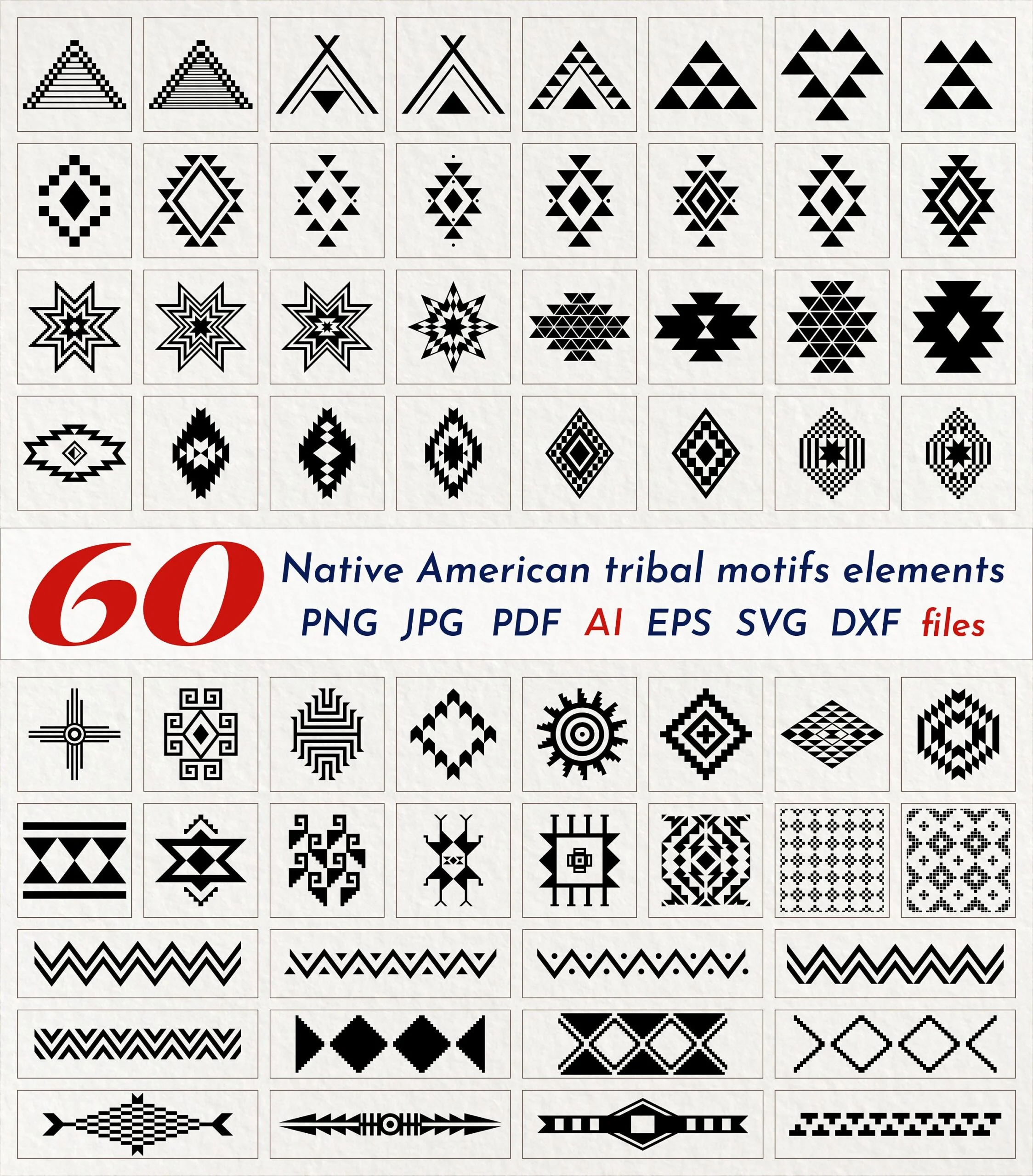
Native American geometric patterns repeat four shapes most often: diamond, step, whirling log, and cross. The table separates Navajo textile motifs from Pueblo pottery and Plains beadwork forms.
| Motif | Tradition | Visual reading | Usual meaning | Modern use |
| Diamond | Navajo weaving, often as an elongated lozenge | Four-cornered form with negative space | Usually read as the four directions or as sacred mountains; varies by community | Large low-contrast tile on a page |
| Step | Pueblo pottery and Southwestern textiles | Stair-like terrace or stepped triangle | Reading changes by Pueblo community | Use as a border at reduced opacity |
| Whirling log | Navajo and other Indigenous contexts | Four-armed rotational form, often with curved arms | A sacred directional symbol with its own Indigenous history; not the later swastika | Avoid as casual tile decoration |
| Cross | Plains beadwork and Pueblo forms | Cross or four-point star, often framed | Varies by nation; confirm the tradition before use | Small connector in a bead-like border once confirmed |
The step and cross are not interchangeable: a stepped Pueblo terrace is not the same as a Plains beadwork cross, even when both tile well. If you cannot name the nation or tradition behind a motif, leave the pattern label generic until you can.
Palette and Materials in Indigenous Textiles and Beadwork
Indigenous beadwork patterns carry a tighter historical palette than most stock libraries suggest. Turquoise, red ochre, black, and white recur in woven and beaded work. Loom-woven wool supports long diamond fields and stepped borders; glass beads, widely available from about 1850 according to collection notes at the National Museum of the American Indian, favored compact crosses, stars, and zigzag bands.
Two material rules follow. First, the palette is not decorative. Each hue in these traditions works as a value: turquoise and red ochre hold the mid-tones, while black and white set the contrast. Second, materials change the repeat. For how those values behave in a composition, see the guide on palette choices in Indigenous designs. That beadwork texture also transfers into paper and collage; see beadwork texture in mixed media.
Where These Motifs Work in Page and Textile Design
A geometric motif repeats well when the tile is seamless and the contrast is low. Start with a large diamond or step; set it at 400–600 px square and check the seams before you judge the motif. In CSS, use background-repeat: repeat only if the tile is clean, and lower the opacity if your motif fights the text.
The studio guide to seamless backgrounds explains how to turn a motif into a seamless repeat. The key rule is legibility: if text must sit over the pattern, keep the motif below a 4.5:1 contrast ratio against the text.
Using the Motifs Without Mixing Traditions
Do not group Native American, Aztec, and Mayan motifs under one catch-all label. A diamond from a Navajo weaving is not interchangeable with a stepped form from a Maya textile. Before you name a motif, confirm the nation or tradition behind the reference. Avoid sacred symbols such as the whirling log in decorative repeats. Keep separate traditions separate: not every named geometric motif is a Native American design.
Sources
Metropolitan Museum of Art, Heilbrunn Timeline of Art History. National Museum of the American Indian, collection records for woven and beaded works.
FAQ
What is the difference between Native American and Aztec or Mayan motifs?
They come from distinct peoples and regions and should not be grouped as one decorative style.
What does the diamond motif mean in Navajo textiles?
It is usually read as the four directions or as sacred mountains, but the meaning varies by community and context.
Can I use Native American patterns in design work?
Yes, with caution: confirm the tradition, avoid ceremonial motifs, and do not use generic patterns sold as “ethnic” designs.
Is the whirling log the same as the swastika?
Visually related, but it is a symbol with its own origin and reading in several Indigenous nations; avoid confusing them or using it without context.
What are common Native American geometric motifs?
Diamond, step, zigzag, cross, star, and whirling log, among others.


Keep reading