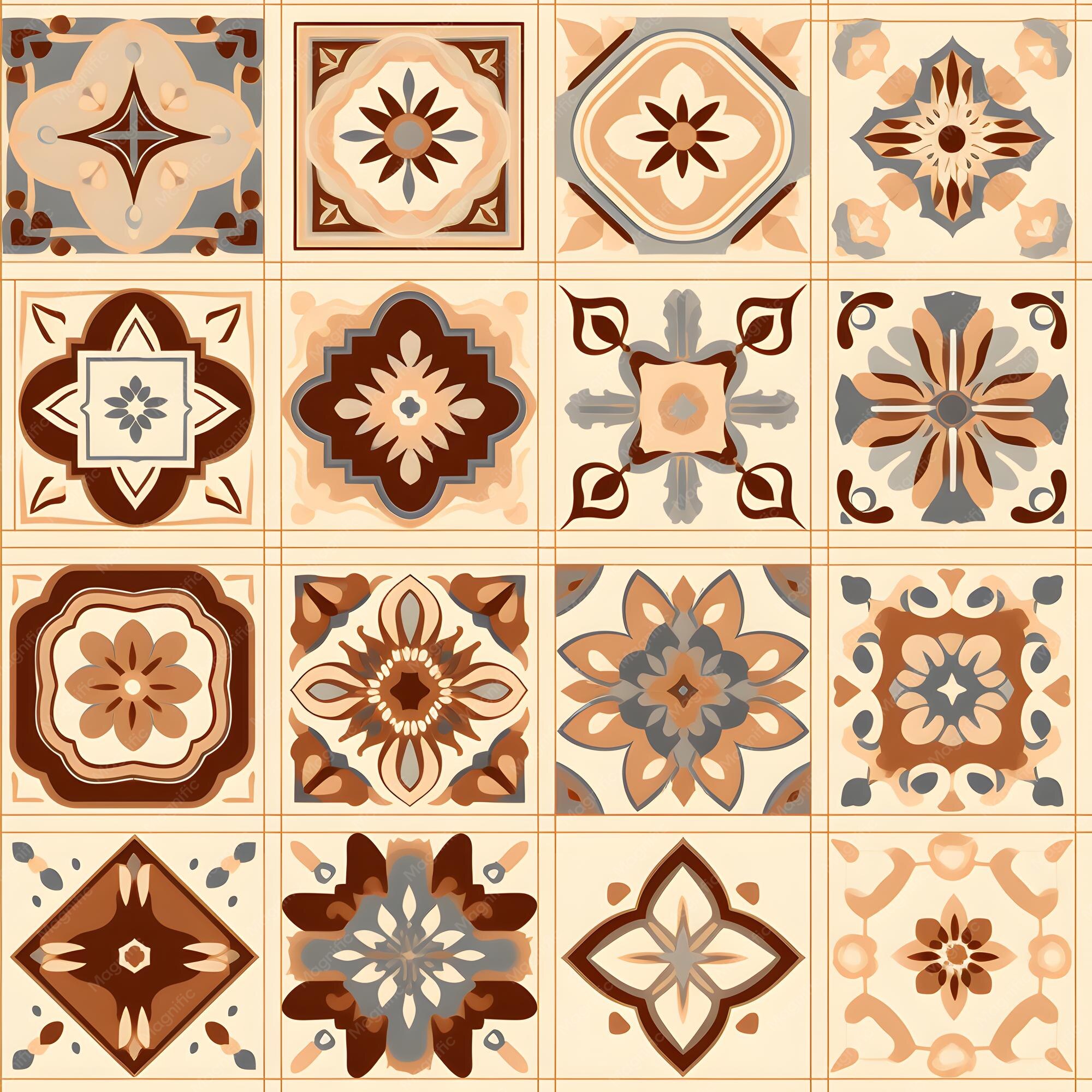

A seamless background tile is a small image whose edges match exactly, so it repeats as a continuous pattern without visible seams. To test it, place four copies in a 2×2 grid and check the joins. The look traces back to ceramic and silk motifs, reused as tiled web page backgrounds in the 1990s.
Table
Definition: What a Seamless Background Tile Is
A seamless background tile repeats without visible joins. A tile is seamless when the left edge continues exactly into the right edge and the top into the bottom. You can spot the difference by zooming: in a true seamless pattern, the corner motifs align across all four sides, and no single repeat stands out. The tile may be a small geometric square, a damask corner, or a low-contrast floral field. What makes it repeat is not the subject but the edge relationship. A continuous ground with balanced negative space helps hide the repeat even when the motif is large. This definition separates a seamless tile from a standalone texture: the repeat has to work before the motif does.
The 2×2 Seam Test
This test checks the repeat before the motif, because a well-drawn motif can still leave an obvious seam. Work with four copies of the same tile at 100 % size.
- Open the tile in a graphics editor and set a canvas four times the tile width and height.
- Place one copy in each quadrant: top left, top right, bottom left, bottom right.
- Align the copies edge to edge with no gaps, offsets, or resampling.
- Zoom to 100 % and look first at the four joins: the vertical center line, the horizontal center line, and both outside edges.
- Check the corners where four tiles meet; misalignment there shows as a step or a broken motif.
- Drag or scroll the image one tile width and see whether the seam follows the motif or the image edge.
Checklist of common failures: a bright edge left from a crop, a one-pixel hairline on one side, color banding where a filter wrapped, and a motif that stops at the border instead of continuing. The order matters because the eye follows dominant shapes first; inspect the seam before you admire the repeat. After the seam passes, place sample text at reading size over the center and the joins. If a dark stripe appears only when you look for it, the tile fails. For repeat units that need more drawing structure, pattern-making techniques can help you build the base tile before the seam test.
The 1990s Page-Background Boom
In the mid-1990s, page backgrounds often came from a small image repeated across the window. The W3C CSS1 Recommendation (December 1996) introduced background-repeat, which let authors specify whether a background image repeated horizontally, vertically, in both directions, or not at all. HTML 3.2 (January 1997) supported the body background attribute, so a page could call an image directly in the markup. Before these standards, early browsers such as NCSA Mosaic displayed images but did not offer consistent tiling control across sites. The combination of body background and background-repeat made the tile a default tool for page design.
Designers used low-contrast textures because monitors of the era had a limited palette, and a busy high-contrast repeat could break text legibility. A tile also had to be small enough to load over dial-up, which favored simple geometric motifs and two-tone fields. The edge-matching requirement stayed the same though the syntax changed: a repeat still needs left-to-right and top-to-bottom continuity. CSS backgrounds can now layer repeating gradients and SVG patterns, but the tile model remains a small image or coded repeat. When you choose a motif today, you are working with the same two conditions that shaped body background: file size and edge alignment. The look of a tiled 1990s page has become a reference point in modern retro web design, but the technical constraint that created it can still be tested with any repeat.
Historical Motifs That Became Seamless Backgrounds
The Victoria and Albert Museum collection dates Delftware to the 17th century and credits Herbert Minton’s encaustic tile process to 1843; Owen Jones documented the underlying geometry in The Grammar of Ornament (1856). These sources link seamless web tiles to older repeat structures, so you can borrow a period motif and keep the edge test. The table lists five durable patterns from design movements that shaped background patterns and how to adapt them.
| Period | Region | Motif | Technique | Example you can adapt |
|---|---|---|---|---|
| 4th c. BCE | Eastern Mediterranean | small repeating geometric floor motif | cut-stone mosaic or tile border | alternating square and diamond grid in two muted colors |
| by the 15th c. | Portugal and Spain | azulejo | tin-glazed earthenware square | corner-linked blue-and-white lattice or eight-point star |
| 17th c. | Netherlands | Delftware | tin-glazed earthenware with cobalt oxide | symmetrical blue corner sprigs on a white ground |
| 1843 | England | encaustic tile | Minton’s inlaid colored clay | quatrefoil or chevron floor pattern in two clays |
| 1856 | England | ornamental grammar | Owen Jones plate-based symmetry | stylized leaf repeat built on a golden-section grid |
These motifs repeat well because each one was designed as a continuous field, not a single picture. The azulejo and Delftware corner motifs carry the eye across the join; the Minton pattern uses geometry; Owen Jones’s grammar makes the repeat systematic. For a web background, reduce saturation and keep the ground neutral to preserve text contrast.
Choosing a Motif and Testing Contrast
A repeating background should support text, not compete with it. The Web Content Accessibility Guidelines (WCAG) 2.1 set the contrast ratio for normal text at 4.5:1, and that number still applies when the background is a patterned tile. You can test how contrast and value affect design by placing sample text over the darkest part of the motif. If the ratio fails, lighten the ground, desaturate the motif, or add a solid overlay under the text block. Use the table below to separate the three properties.
| Property | What to check | Quick test |
|---|---|---|
| Value | Difference in lightness between text and tile | Sample a dark motif area behind text; aim for at least 4.5:1 |
| Hue | Color distance between text and ground | If two hues vibrate, reduce one saturation or move one hue |
| Saturation | Intensity of the pattern behind text | Desaturate the motif until the text edges stay crisp |
When you compare motif candidates, use color value and hue when choosing a motif. A low-contrast damask can pass at full opacity; a bright Delftware pattern usually needs a softened white ground. Large repeat units hide seams but reduce the number of pattern areas for text, so leave a quiet zone behind the main content. If you cannot meet 4.5:1 with the motif itself, add a semi-opaque white layer between the tile and the text.
Motif Glossary
- Damask: a two-tone, mirror-symmetrical pattern of stylized leaves and flowers. The name comes from Damascus silk; the structure works on a web page because the repeat is large and the contrast is low. Use it as a full-page ground or a subtle panel behind headings.
- Delftware: tin-glazed earthenware from the Netherlands, usually blue-on-white, often dated to the 17th century. It uses corner sprigs, windmills, and flowers. Adapt it as a small blue corner repeat on white.
- Azulejo: Portuguese and Spanish glazed tile, often geometric or floral, by the 15th century. It works as a square repeat with strong corner connections.
- Encaustic tile: inlaid colored clay floor tile associated with Minton’s 1843 process in England. Adapt it as a two-color geometric repeat with high edge matching.
- Faience: a broad term for tin-glazed earthenware; in a motif context it usually means glazed ceramic with painted decoration. It can supply a flatter, softer palette than porcelain.
- Morisco: a Spanish architectural term for interlaced, often eight-point geometric ornament built from modules. Its grid structure makes a ready-made seamless repeat.
Before you use any motif, draw it as a single repeat unit and run the 2×2 test; a motif that works historically may still need a one-pixel adjustment to become seamless on screen. For fresh starting points, try drawing ideas for repeating motifs from a still life or a section of a mural.
Frequently Asked Questions
What is a seamless background tile?
A small image whose matching edges repeat without visible joins.
How do I test that a tile repeats cleanly?
Place four copies in a 2×2 grid and check the seams before the motif.
Where did tiled web backgrounds come from?
From ceramic and silk motifs; by the mid-1990s they appeared as body background images.
Which historical motifs repeat without visible seams?
Small geometric azulejo and Delftware motifs; large damask repeats with low contrast.
Why does a damask motif still work on a web page?
Large repeat and low two-tone contrast hide seams.
Sources
- W3C, CSS1 Recommendation (1996)
- Victoria and Albert Museum ceramic collection
- Owen Jones, The Grammar of Ornament (1856)
Color Symbolism in Art: How Colors Convey Emotions and Ideas

Creative Drawing Ideas to Boost Your Artistic Skills

How to Analyze a Painting Like a Professional Critic

Art History: A Complete Timeline of Art Movements from Renaissance to Modern Art

Frida Kahlo: The Life, Art, and Legacy of a Revolutionary Icon 🎨✨

Cosmetic Painting: Techniques, Applications, and Professional Tips